Air Traffic Controller Software: What Features Should You Look For?
in the Aviation World , every second matters. One small miscommunication or delay can impact hundreds of passengers, disrupt airline schedules, and compromise airspace safety. That’s why air traffic controller software—also referred to as air traffic control software or air traffic management software—is at the heart of modern aviation operations.
To provide firsthand insights, we consulted Ali Usman, a certified Aerodrome Flight Information Instructor with extensive experience in air traffic services and aviation operations. His experience in both civil and military aviation environments offers practical advice on selecting the right air traffic management solution.
Whether you’re managing a busy international airport, a military airbase, or a private airstrip, selecting the right air traffic software is critical for safety, efficiency, and compliance.
Why Air Traffic Management Software Matters
Air traffic has quadrupled over the last two decades, and airports worldwide are handling record-breaking volumes. Without advanced air traffic management (ATM) systems, controllers would face:
- Overwhelming workloads leading to potential errors
- Increased risk of runway incursions or airspace conflicts
- Inefficient scheduling and delays costing airlines millions
Ali Usman shares:
“When I started in air traffic services, much of the work relied on manual coordination and voice communication. Today, without integrated air traffic management automation systems, the volume of flights we handle would be unmanageable.”
For instance, London Heathrow handles over 1,300 flights daily, and the FAA manages over 45,000 flights per day in the United States. Automation and decision-support tools aren’t just helpful—they’re mission-critical.
Modern air traffic management software allows controllers to:
- Track multiple aircraft in real-time
- Predict potential conflicts before they happen
- Coordinate with adjacent airports and sectors seamlessly
- Enhance safety while reducing controller workload
1. Real-Time Aircraft Tracking & Surveillance
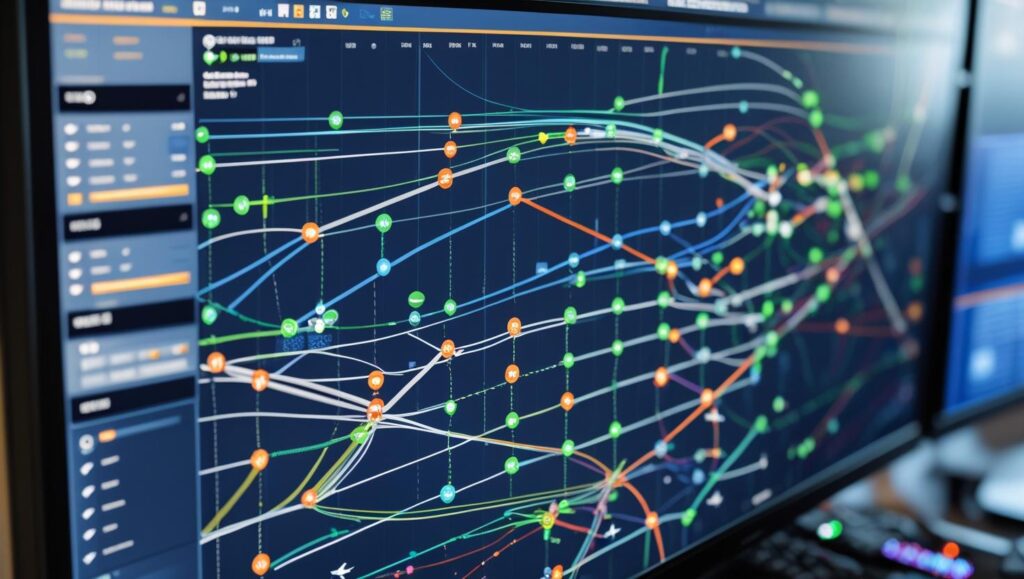
One of the core features of any air traffic controller software is real-time aircraft tracking.
Ali Usman explains:
“Real-time surveillance gives controllers confidence. Knowing exactly where each aircraft is, at any given moment, is the foundation of safe and efficient air traffic control.”
Advanced surveillance and radar integration ensures that:
- Aircraft positions are updated every second
- Controllers can monitor altitude, speed, and heading accurately
- ADS-B (Automatic Dependent Surveillance-Broadcast) and MLAT (Multilateration) data are fully supported
Example:
The EUROCONTROL Network Manager integrates multiple data feeds, allowing controllers to visualize real-time air traffic across Europe, reducing blind spots and improving coordination.
Tip:
Look for a solution that supports both primary and secondary radar, ADS-B, and satellite-based feeds for maximum coverage and redundancy.
2. Conflict Detection & Predictive Analytics
In the fast-paced airspace environment, controllers need to anticipate problems before they occur.
Modern air traffic management software uses predictive algorithms to:
- Detect potential aircraft conflicts well in advance
- Recommend safe, fuel-efficient trajectory changes
- Optimize runway sequencing to reduce congestion
Ali Usman adds:
“The ability to predict and prevent conflicts before they require urgent action is a game changer. It keeps both the aircraft and the controllers safer.”
Real-Life Insight:
The FAA’s Time-Based Flow Management (TBFM) tool uses predictive analytics to minimize holding patterns, saving airlines millions in fuel while enhancing safety.
3. Seamless Communication & Coordination
Effective communication between controllers, pilots, and adjacent sectors is non-negotiable.
Your air traffic software should provide:
- Integrated voice and data communication systems
- Digital handoff and coordination tools with other ATC units
- Automatic alerting for handover and sector changes
Ali Usman emphasizes:
“Miscommunication is one of the biggest risks in air traffic services. Integrated ATC communication tools reduce errors and make handovers smooth and secure.”
Military & defense aviation often require encrypted communication channels to ensure security, while civil aviation focuses on redundancy and clarity.
4. Advanced Air Traffic Management Automation
The best air traffic management software doesn’t just display data—it automates repetitive tasks, freeing controllers to focus on critical decisions.
Automation capabilities may include:
- Automatic flight plan processing and validation
- Automated handoffs between sectors and airports
- Automated runway and gate assignments
- Weather and NOTAM (Notice to Air Missions) integration
Example:
Singapore Changi Airport uses an advanced air traffic management automation system to handle peak-hour traffic without increasing controller fatigue.
Why It Matters:
Automation reduces workload, minimizes delays, and enhances safety, which is especially critical in complex or congested airspaces.
5. Scalability & Multi-Airport Management
If you’re managing a national airspace or multiple regional airports, your air traffic control software must be scalable.
Look for solutions that can:
- Manage multiple runways and sectors simultaneously
- Expand coverage without system downtime
- Integrate with legacy and next-gen ATC systems
Ali Usman notes:
“Air traffic demand grows every year. Choosing scalable systems ensures your operations won’t outgrow your technology in just a few years.”
6. Compliance, Safety & Regulatory Standards
Aviation is one of the most regulated industries in the world.
Your air traffic management software must comply with:
- ICAO standards (International Civil Aviation Organization)
- FAA, EASA, and EUROCONTROL regulations for your region
- Cybersecurity and safety protocols
Safety Tip:
Ensure your system includes redundancy features, failover servers, and continuous data logging for post-event analysis.
7. Intuitive Interface & Controller-Friendly Design
Even the most advanced air traffic software is useless if it’s difficult to operate.
Look for:
- Customizable dashboards for tower, approach, and en-route operations
- Color-coded alerts for priority actions
- Touchscreen or multi-display support for situational awareness
Ali Usman adds:
“A user-friendly interface reduces stress in high-pressure environments. When seconds matter, controllers need clarity, not complexity.”
8. Integration With Smart Airport & IoT Solutions
The future of air traffic management is smart and connected.
Choose air traffic control software that can integrate with:
- Smart runway lighting and IoT-based ground systems
- Airport resource management systems (ARMS)
- Weather and drone management platforms
Example:
Dubai International Airport uses IoT-integrated ATM solutions to predict congestion, optimize taxiing, and enhance safety.
Conclusion: Expert Advice on Choosing the Right Software
Choosing the right air traffic management software is a long-term investment in safety, efficiency, and operational excellence.
Ali Usman concludes:
“From my experience in air traffic services, the best systems are the ones that combine real-time awareness with predictive intelligence. They make controllers’ jobs easier, safer, and more efficient.”
When evaluating solutions, prioritize:
- Real-time surveillance and tracking
- Predictive analytics and conflict detection
- Seamless communication tools
- Automation and smart integrations
- Compliance, scalability, and user-friendly interfaces
FAQs About Air Traffic Controller Software
1. What is air traffic controller software?
Air traffic controller software is a specialized system that helps monitor, manage, and coordinate aircraft movements to ensure safety and efficiency in controlled airspace.
2. Why is air traffic management software important?
It reduces human error, prevents collisions, optimizes runway usage, and supports regulatory compliance for both civil and military aviation.
3. What features should I look for in air traffic control software?
Look for real-time tracking, conflict detection, automated flight plan management, communication tools, and regulatory compliance features.
4. Can modern air traffic software integrate with existing airport systems?
Yes. Advanced air traffic systems can integrate with IoT devices, runway systems, weather feeds, and legacy ATC networks for seamless operations.
5. How does air traffic management automation improve safety?
Automation reduces workload, predicts conflicts earlier, and ensures faster, data-driven decision-making, which enhances safety and efficiency.